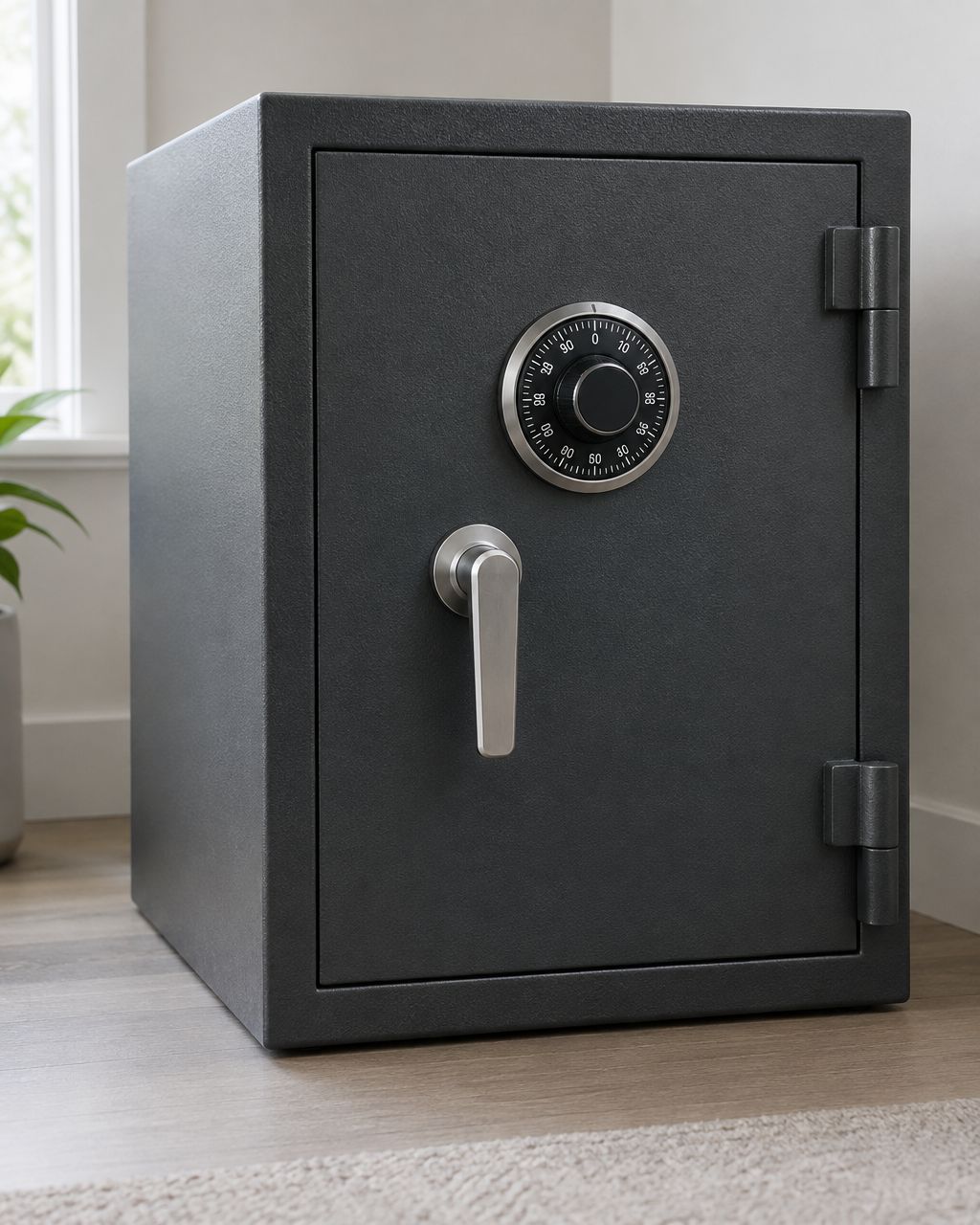
For a home office, choose a fire-resistant safe by the records you need to protect and the exact model's documented protection. Paper files and electronic backups can have different requirements. The word fireproof is not a promise against every fire, and a fire rating is not proof of burglary or water protection.
- Home-office safe selection starts with paper, electronic media, and recovery needs.
- Read the exact model's classification and permitted contents.
- Fire, water, and burglary protection are different checks.
- GO Locksmith offers safe service; sales, moving, and anchoring are not confirmed services.
Classify your records before choosing a container
List original documents, replaceable business paperwork, and electronic storage separately. Consider which records can be recovered from another secure location or backup if the room becomes inaccessible.
The Southwest Florida home-safe guide addresses broader protection and placement. A home office adds a record-recovery problem: protecting one container is not the same as preserving your ability to operate.
| Contents | Selection question | Separate safeguard |
|---|---|---|
| Original paper records | Does the documented classification suit paper? | Secure record of contents and recovery contacts |
| Electronic storage | Does the specific model claim suitable protection for that media? | Independent tested backup |
| Mixed records and valuables | Which risks does the model actually address? | Appropriate custody and access arrangements |
Do not transfer a rating from one model to another or assume a paper classification covers every electronic device.
Read the evidence behind the product label
UL Solutions explains fire and burglary assessments separately. Manufacturer materials can also describe specific water tests and media claims. Read the classification, duration, supported contents, and restrictions together rather than treating a bold product name as the specification.
Ask the seller for the documentation for the exact product being supplied. If the required content protection is not established, do not fill the gap with a generic category assumption.
This guide does not rank unverified models or quote product prices. A documented, appropriate container is more useful than an unsupported best-product claim.
Make recovery information available outside the safe
Keep authorized access records and manufacturer recovery information securely outside the locked container. If your only record of the combination and proof of ownership is inside, a forgotten credential becomes harder to resolve.
Agree who may access the office records and who can act if the normal user is unavailable. Do not distribute combinations widely simply to make recovery convenient.
Consider placement without improvising installation
Check the proposed location, access space, load considerations, and manufacturer instructions. Do not drill the safe or floor based on a general anti-theft tip; alterations can conflict with the product or building requirements.
A fire-resistant container should not be treated as protection against all water exposure. Assess that risk separately using the documented model limits and the property's actual conditions.
GO Locksmith's confirmed safe service can be discussed for a particular existing-safe problem. This does not imply it sells, moves, anchors, or supports every model.
Keep your business recovery plan separate
Test independent backups and store appropriate recovery contacts away from the office where needed. A safe that protects a document does not make it immediately accessible after a building incident.
Organize the contents so you can identify what was stored without exposing confidential details in an ordinary service enquiry. If the safe develops a fault, provide model information and symptoms, not sensitive client records.
FAQ
Are fireproof safes protected from every fire?
No universal protection is promised. Read the exact model's documented classification and limits.
Does paper protection also cover digital media?
Not automatically. Confirm the specific media claim and maintain independent backups.
Is a fire-rated safe also burglary-rated?
Those are separate assessments. Check each protection claim independently.
Should I keep the only combination record inside?
No. Keep authorized recovery information securely accessible outside the locked safe.
Can GO Locksmith supply and move a home-office safe?
Those services are not confirmed. Call about the specific safe-service task rather than assuming sales or transport.
Discuss an existing safe problem
Call GO Locksmith at (239) 412-1101 with visible model details and the fault to check supported safe service and availability. Avoid sharing confidential contents in public messages.