Best default for everyday home entry: a standalone keypad deadbolt. Best for managing access away from home: a connected keypad deadbolt. Best for avoiding batteries: a mechanical keypad lock. Best for retaining compatible existing hardware: a retrofit lock with an external keypad. Choose the configuration around your door, its exposure to weather, and how you need to manage access—not the longest feature list.
- The best keypad locks for Florida homeowners match the door, weather exposure, and household access needs.
- Standalone keypad deadbolts suit everyday entry without remote access management.
- Connected keypad deadbolts suit homeowners who need to manage supported access features away from home.
- GO Locksmith provides mobile residential lock repair, replacement, rekeying, and fresh installation in Fort Myers.
A keypad changes how you enter your home; it does not correct a sagging door or make an unsuitable lock weatherproof. GO Locksmith is a mobile locksmith service serving Fort Myers and other confirmed Southwest Florida communities.
Why Florida homeowners need more than a keypad
An exterior lock must work with the whole doorway: the door, frame, strike, weather seals, and existing hardware. A covered entrance and an exposed coastal entrance present different conditions. Check the manufacturer's exterior-use instructions rather than assuming that a residential keypad belongs on every outside door.
Choose the door fit first, the access method second, and connected features last. That order keeps convenience from hiding a hardware problem. If you must lift the door or push it hard to turn the current deadbolt, address that resistance before adding a keypad.
This guide ranks lock configurations by household use. It does not rank manufacturers by security, durability, or service quality; those comparisons require evidence for the exact models being considered.
What makes a good keypad lock for a Florida home?
Use these criteria before comparing individual products:
- Exterior suitability: Check the documented operating conditions, permitted exposure, and care instructions for the exact model. An exterior keypad does not establish that every component tolerates direct rain or salt exposure.
- Door compatibility: Confirm door thickness, bore preparation, backset, handing, and clearance against the installation instructions. A keypad deadbolt is not a universal replacement for every entry lock.
- Reliable bolt movement: The bolt should move without forcing the door into position. Door alignment matters whether you operate the lock by hand or with a motor.
- Access management: Decide whether household codes are enough or whether you need supported remote changes, guest schedules, or activity records. These are separate features, not automatic benefits of every keypad.
- Backup entry: Understand the exact lock's low-power behavior and recovery method before installation. A key cylinder, external power connection, and battery-free operation are different arrangements.
- Maintainability: Review battery access, code-change instructions, cleaning guidance, and any manufacturer restrictions. Choose something the household can operate and maintain confidently.
Keypad lock configurations at a glance
| Lock configuration | Best for | Standout benefit | Key limitation |
|---|---|---|---|
| Standalone keypad deadbolt | Everyday household entry | Local code entry without remote management | Codes generally require management at the lock |
| Connected keypad deadbolt | Access management away from home | Supported remote access features | Remote functions depend on the specified connection setup |
| Mechanical keypad lock | Battery-free entry | Mechanical code operation | Code changes and door fit depend on the mechanism |
| Retrofit keypad setup | Retaining compatible hardware | Adds keypad control to supported existing hardware | Compatibility must cover both the lock and keypad |
Each configuration has a different job. A connected lock is not automatically the right upgrade for a household that only wants to stop carrying a key on walks.
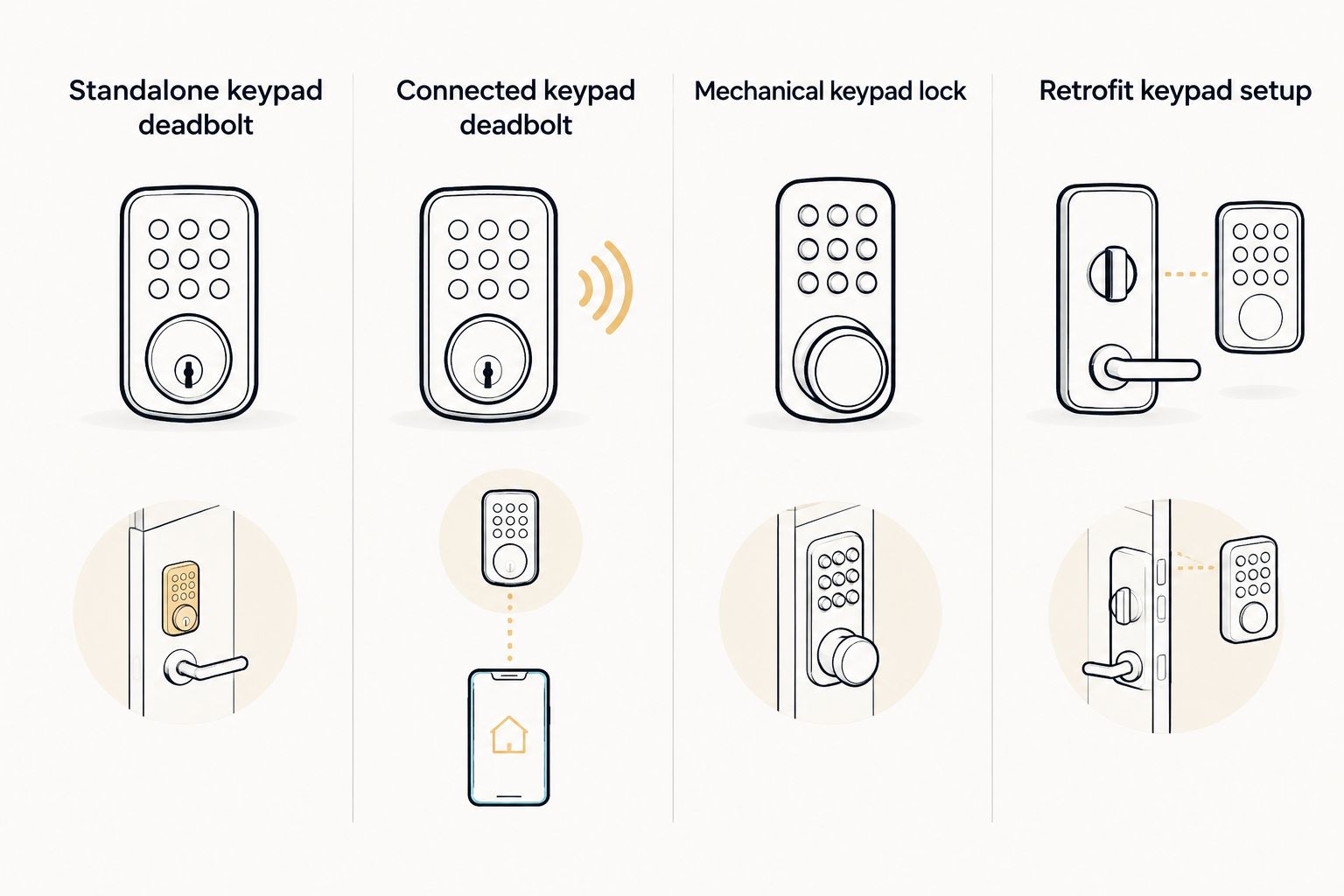
1. Standalone keypad deadbolt: best for everyday household entry
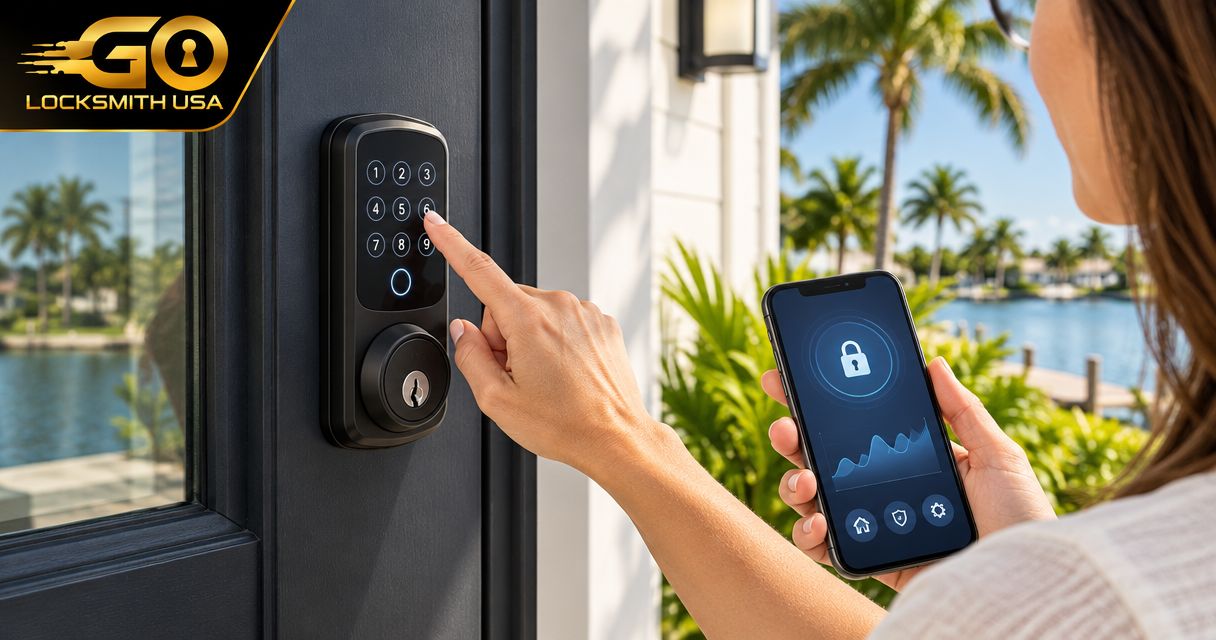
A standalone keypad deadbolt lets you enter a code at the door without relying on remote access management. Electronic versions use batteries; their available code features and backup methods vary by model. This is the clearest starting point when your goal is convenient daily entry rather than managing the door from elsewhere.
Best for: Homeowners who want local keypad access for household members and do not need to change access remotely.
Standalone keypad deadbolt pros
- Local entry does not require an internet connection.
- You avoid configuring remote-access accounts and network equipment.
- The feature set stays focused on entering and securing the door.
- Models with suitable code-management features can give household members separate codes.
Standalone keypad deadbolt cons
- Changing access generally requires someone at the lock.
- Electronic models still require battery maintenance.
- Temporary schedules and entry records are not standard features across the category.
For a Florida entrance, inspect the exact model's exposure instructions and installation requirements. Do not assume a keypad face can sit in driving rain simply because the product is described as an entry lock. Also check whether the interior assembly has enough clearance from nearby trim or other door hardware.
Keep the programming instructions accessible somewhere other than behind the locked door. Give household members the backup-entry information they need, and distinguish an everyday entry code from an administrative code where the model uses both.
Verdict: Buy a standalone keypad deadbolt if local code entry solves your problem and the exact model fits your door.
2. Connected keypad deadbolt: best for managing access away from home
A connected keypad deadbolt combines code entry with supported app or network functions. Depending on the model and setup, those functions can include remote code management, access schedules, or activity information. Confirm each function in the manufacturer's documentation instead of treating connected access as a single standard feature.
Best for: Homeowners who need to manage supported door-access functions while away from the property.
Connected keypad deadbolt pros
- Supported remote code changes reduce the need to visit the door to manage access.
- Models with scheduling features can separate routine household access from guest access.
- Supported activity records can help you review lock events.
- Local keypad entry and remote management serve different household needs in one setup.
Connected keypad deadbolt cons
- Remote functions depend on the required network, bridge, or other connection arrangement.
- Accounts, permissions, and software updates add maintenance tasks.
- An app status message is not a substitute for checking physical door closure.
Before choosing a connected lock, identify the feature you actually need. Receiving lock notifications is different from changing a code remotely, and both differ from confirming that a door is closed. Check whether a feature needs additional hardware and whether it remains useful when the home's internet connection is unavailable.
Use separate account permissions where supported, and remove access that is no longer needed. Avoid sharing the main administrative login with everyone who needs to enter the house. For occasional visitors, select a model whose documented guest-access controls match your routine.
Verdict: Buy a connected keypad deadbolt for a defined remote-access need; skip the added complexity if local codes are enough.
3. Mechanical keypad lock: best for battery-free entry
A mechanical keypad lock uses a physical combination mechanism rather than battery-powered code recognition. The category includes different lock and latch arrangements, so the exact product must match the door's preparation and required locking function. Do not assume every mechanical keypad replaces an existing deadbolt.
Best for: Homeowners who specifically want code entry without battery maintenance or connected accounts.
Mechanical keypad lock pros
- The mechanical code mechanism does not need batteries.
- Code entry does not depend on a home network or app account.
- It suits a household that prefers a physical operating routine.
Mechanical keypad lock cons
- Remote code changes and electronic access records are not part of a purely mechanical setup.
- Changing the combination can involve a model-specific hardware procedure.
- Door preparation and locking arrangements differ across products.
Battery-free does not mean maintenance-free. Exterior hardware still needs appropriate exposure protection and manufacturer-directed care. Check corrosion guidance, permitted cleaning methods, and whether the lock is intended for the conditions at your entrance.
Try the operating sequence before deciding, especially if someone in the household has difficulty pressing small buttons or turning hardware. Confirm how you change a code and who can perform that task. A lock that avoids batteries but makes routine access changes difficult is not automatically a simpler choice.
Verdict: Buy a mechanical keypad lock when battery-free operation matters most and its door fit and operating sequence work for your household.
4. Retrofit keypad setup: best for retaining compatible hardware
A retrofit setup adds supported electronic control to compatible existing lock hardware, with a keypad serving as an entry method. Some arrangements retain the exterior keyed portion while changing the interior operating hardware. Compatibility must be established for the exact existing lock, retrofit device, and keypad combination.
Best for: Homeowners who want keypad access while retaining suitable existing hardware.
Retrofit keypad setup pros
- A compatible arrangement can retain the exterior keyed hardware.
- You can evaluate keypad access without automatically replacing every lock component.
- It suits doors where retaining the existing exterior hardware matters.
Retrofit keypad setup cons
- Not every deadbolt, multipoint lock, or door preparation is compatible.
- A separate keypad introduces another component to mount and maintain.
- Existing wear or alignment problems remain unless addressed separately.
Start by identifying the current lock, not by choosing an app. Compare its mechanism and dimensions with the retrofit manufacturer's compatibility requirements. If the existing cylinder is worn or the bolt binds, retaining it preserves the problem rather than solving it.
For a recently purchased home, retaining a key cylinder also leaves a separate question: who has working keys? Read the guide to rekeying locks when moving into a new home. Changing keypad codes does not invalidate physical keys.
Verdict: Hold until compatibility is confirmed; buy a retrofit keypad setup only when the existing hardware is suitable to keep.
Before you replace the lock on an impact-rated door
An impact-rated entrance is a door assembly, not just a lock. Check the door manufacturer's instructions and applicable approval documents before changing hardware or drilling new holes. A keypad lock does not give an ordinary door hurricane protection.
If the entrance uses a multipoint system, identify it before shopping for a conventional keypad deadbolt. Different mechanisms are not interchangeable simply because both secure a front door. Ask about the exact hardware arrangement rather than requesting a generic smart-lock replacement.
For an HOA or condominium, check applicable exterior-hardware requirements before making changes. Permission to alter the appearance and technical suitability are separate questions. Neither proves the other.
How these configurations are ranked
The ranking follows the criteria above: fit, exposure, access needs, backup entry, and maintenance. Standalone keypad entry is the default because it directly addresses everyday code access. Connected, mechanical, and retrofit options take their places when remote management, battery-free operation, or hardware retention is the deciding requirement.
A category recommendation is not approval of every product in that category. Check the exact model and door together before buying.
Which keypad lock should you choose?
Choose a standalone keypad deadbolt if you want straightforward household entry and can manage codes at the door. Move to a connected model only when you need its documented remote features. Choose mechanical operation to avoid batteries, or a retrofit arrangement to retain verified compatible hardware.
GO Locksmith provides mobile residential lock repair, replacement, rekeying, and fresh installation. For a keypad-related request, describe your current door and hardware so the specific job can be discussed without assuming compatibility. Call (239) 412-1101 to check availability or request a job-specific estimate.
Service hours are Sunday–Thursday, 7:00 AM–11:00 PM; Friday, 7:00 AM–5:00 PM; Saturday closed. GO Locksmith is not a 24/7 service.
FAQ
What's the best keypad lock for a Florida homeowner who doesn't need an app?
A standalone keypad deadbolt is the default configuration for local code entry without remote management. Choose an exact model that fits your door and has documented suitability for its exterior exposure.
Are keypad locks suitable for Florida rain and humidity?
Suitability depends on the exact lock's documented operating conditions and exposure limits. Check the manufacturer's instructions for the keypad, exterior hardware, and interior assembly rather than assuming all keypad locks tolerate the same conditions.
Will my keypad lock work if the internet goes out?
A standalone keypad lock does not need the internet for local code entry. For a connected lock, check the manufacturer's documentation for local operation and which remote functions become unavailable when its connection is lost.
What happens when a keypad lock's batteries die?
The backup-entry method depends on the model. Check its low-battery warnings and whether it uses a mechanical key, an external power connection, or another documented recovery method before relying on it.
Can I put a keypad lock on a hurricane-rated door?
Compatibility must be checked against the door assembly and its approved hardware requirements. Do not drill new holes or substitute hardware without reviewing the door manufacturer's instructions and applicable approval documents.
Does changing the keypad code disable an old house key?
No, changing a keypad code does not disable a physical key that operates a retained key cylinder. Rekeying or replacing the keyed hardware addresses that separate access route.
Can GO Locksmith help with a residential lock replacement?
GO Locksmith offers mobile residential lock repair, replacement, rekeying, and fresh installation. Call (239) 412-1101 during the stated service hours to discuss the door, the requested hardware, and current availability.
One last thing: test the lock with the door closed
A lock that operates smoothly with the door open has not passed the full check. Test normal operation with the door closed, following the manufacturer's setup instructions, and check for resistance without forcing the mechanism. Do not use a stronger motor as a substitute for correcting door alignment.