Best for resident-managed condo doors: Schlage Encode. Best for choosing keyed or key-free entry: Yale Assure Lock 2. Best for preserving existing exterior hardware: August Wi-Fi Smart Lock. For centrally managed communities, shortlist Schlage Control for unit access and SALTO XS4 for shared-door projects; the best smart locks for HOA and condo communities depend on who controls each door, not just which app opens it.
- Schlage Encode leads this best smart locks for HOA and condo communities shortlist for resident-managed doors.
- Yale Assure Lock 2 suits buyers choosing between keyed and key-free configurations.
- August Wi-Fi Smart Lock suits compatible doors where existing exterior hardware must remain.
- Schlage Control and SALTO XS4 belong on a community-managed access shortlist, subject to system and door compatibility.
- GO Locksmith provides mobile lock services; call to discuss the specific door and requested work.
A lock purchase and a locksmith service are separate decisions. GO Locksmith provides mobile residential and commercial lock repair, replacement, rekeying, and fresh installation; discuss the proposed hardware before assuming a particular smart-lock installation is supported.
What makes a smart lock suitable for an HOA or condo?
Use these criteria before comparing brands:
- Door compatibility: Match the lock to the existing preparation, thickness, latch, and hardware. A residential deadbolt is not a substitute for every commercial lock.
- Access ownership: Decide whether the resident, association, or property manager creates and removes credentials.
- Approval requirements: Check association rules before changing exterior hardware, drilling, or altering an entry door.
- Failure recovery: Establish what happens when batteries, a phone, internet access, or an administrator account become unavailable.
- Credential management: Check how residents, contractors, and departing staff receive and lose access.
- Maintenance responsibility: Assign battery replacement, account administration, hardware repairs, and lockout handling before installation.
A smart lock is suitable only when its physical fit and access policy both match the door. Wireless features cannot correct an incompatible latch or unclear responsibility for resident access.
Smart locks at a glance
| Option | Best for | Standout feature | Key limitation |
|---|---|---|---|
| Schlage Encode | Resident-managed condo entries | Built-in Wi-Fi with keypad and mechanical-key entry | Consumer app management is not equivalent to community-wide access administration |
| Yale Assure Lock 2 | Choosing keyed or key-free entry | Multiple hardware and connectivity configurations | Features differ by exact configuration |
| August Wi-Fi Smart Lock | Keeping existing exterior hardware | Interior retrofit on compatible single-cylinder deadbolts | Not a universal fit for mortise or interconnected hardware |
| Schlage Control | Association-managed unit access | Electronic credential access designed for multifamily settings | Requires a compatible management arrangement and recovery plan |
| SALTO XS4 | Shared doors in a managed access project | Electronic locking options within the SALTO access ecosystem | Hardware, software, and door requirements need project-specific selection |
These recommendations distinguish use cases rather than claim one product is best on every door. Product descriptions refer to the manufacturers' published product families; verify the exact model's current installation instructions and configuration before ordering.
Why this matters in a condo community
A condo unit door and a clubhouse entrance have different users and responsibilities. Your unit door might be resident-controlled, while the association needs to manage access to shared spaces. Buying the same consumer lock for both does not settle that distinction.
Association approval also does not establish technical compatibility. A door can have appearance restrictions, fire-rating requirements, or existing hardware that limits acceptable modifications. Treat approval and hardware review as separate checks.
For the wider service questions around resident and shared doors, see the guide to locksmith services for HOAs and condos.
1. Schlage Encode: best for resident-managed condo entries
Schlage Encode is a replacement smart deadbolt with built-in Wi-Fi, keypad entry, and a mechanical key cylinder. It fits the shortlist when a resident controls an individual entry and wants to manage access through a consumer-facing system.
Its value here is straightforward: visitors can use an assigned code rather than borrow a physical key. However, a resident-managed app does not automatically give an association the permissions, reporting, or account structure it needs across multiple units.
Schlage Encode pros:
- Keypad entry provides an alternative to using a phone at the door.
- A mechanical key provides a separate entry method.
- Built-in Wi-Fi avoids the need for a separate Wi-Fi bridge for this model.
Schlage Encode cons:
- Replaces visible exterior deadbolt hardware, making association approval relevant.
- Requires an assigned battery-maintenance routine.
- Does not establish community-wide administrative control merely by being connected.
Before choosing Schlage Encode, confirm that the association permits the exterior change and that the resident should own the account. Also check how authorized access will work if that resident moves out.
Best for: A condo owner managing an approved individual entry, rather than a board managing shared credentials.
Verdict: Buy for an approved resident-managed door; skip as an assumed building-wide access platform.
2. Yale Assure Lock 2: best for choosing keyed or key-free entry
Yale Assure Lock 2 is a smart-lock family with keyed and key-free configurations, along with different keypad, touchscreen, and connectivity options. That range makes it useful when the association and resident need to agree on how entry and backup access should work.
Choose the configuration first, then assess its features. A capability shown for one Assure Lock 2 version does not establish that every version includes it.
Yale Assure Lock 2 pros:
- Offers a choice between retaining a key cylinder and using key-free hardware.
- Provides keypad or touchscreen options within the family.
- Lets buyers select a connectivity configuration rather than assume every door needs the same setup.
Yale Assure Lock 2 cons:
- Similar product names make configuration checks essential.
- Key-free versions require a recovery plan that does not depend on a conventional key cylinder.
- Exterior hardware changes still require any applicable association approval.
Ask for the exact model identifier in the purchase proposal. Check that model's instructions for battery depletion, external emergency power where applicable, and remote-management requirements. Do not accept a general statement that all Yale locks work identically.
Best for: Residents and associations deciding whether a unit entry should retain mechanical-key access.
Verdict: Buy after selecting the exact configuration; hold if the proposal names only the product family.
3. August Wi-Fi Smart Lock: best for retaining exterior hardware
August Wi-Fi Smart Lock replaces the interior thumbturn of a compatible single-cylinder deadbolt while retaining the exterior hardware and key cylinder. That retrofit approach makes it relevant when changing the outside appearance of a condo door is undesirable.
Keeping the exterior does not remove the need for permission. The association can still regulate modifications, key arrangements, or access responsibilities, and the existing deadbolt must be compatible with the retrofit.
August Wi-Fi Smart Lock pros:
- Retains the existing exterior lock appearance on compatible installations.
- Keeps the existing mechanical-key entry arrangement.
- Adds connected control without replacing the entire deadbolt assembly.
August Wi-Fi Smart Lock cons:
- Does not fit every deadbolt or door-hardware arrangement.
- Retains existing mechanical hardware, including any unresolved wear or alignment problems.
- Interior clearance and mounting suitability still need checking.
Check the manufacturer's compatibility information against the actual deadbolt, not just the door's appearance. Mortise locks, interconnected hardware, and unusual interior layouts require separate consideration; do not treat an interior retrofit as universal.
Best for: An approved individual condo entry with a compatible deadbolt and a reason to keep its exterior hardware.
Verdict: Buy when compatibility and approval are confirmed; skip when preserving the exterior hides an unsuitable existing lock.
4. Schlage Control: best for association-managed unit access
Schlage Control is electronic locking hardware intended for multifamily access applications. It belongs on the shortlist when management needs credential-based unit access rather than separate resident-owned consumer accounts.
The important decision is the management arrangement around the lock. Confirm the proposed system, credential types, administrator permissions, and procedures for resident turnover before committing to hardware.
Schlage Control pros:
- Designed around multifamily access requirements.
- Uses electronic credentials rather than making a resident's phone the only access concept.
- Supports planning around managed unit access instead of isolated household accounts.
Schlage Control cons:
- Requires compatible management components and a clearly defined operating process.
- Credential enrollment and removal become ongoing administrative responsibilities.
- Recovery and maintenance procedures need confirmation for the exact configuration.
Request a demonstration of the proposed resident move-in and move-out workflow. Establish who can issue credentials, who can revoke them, and what happens when the person administering the system leaves their role. A hardware specification alone does not answer those questions.
Best for: A condo association or property manager planning centrally administered unit-entry credentials.
Verdict: Hold until the complete management and recovery plan is documented; buy hardware only as part of that plan.
5. SALTO XS4: best for shared-door access projects
SALTO XS4 is an electronic locking family used within SALTO access-control systems. It is relevant to a shared-door project where managers need to evaluate hardware and credential administration together.
Treat SALTO XS4 as a system shortlist, not a single interchangeable lock. The selected hardware, software arrangement, and door application determine what the installation can do.
SALTO XS4 pros:
- Offers hardware choices within an established access-control ecosystem.
- Suits planning around managed credentials for shared access.
- Provides a route for evaluating multiple door applications within one project.
SALTO XS4 cons:
- Requires more specification work than choosing an individual residential deadbolt.
- Integration and remote functions depend on the proposed system components.
- Shared doors require separate checks for egress, door operation, and applicable approvals.
For a clubhouse or common entrance, document who needs access and when it should end. Also identify existing closers, exit hardware, and door conditions before selecting a locking component. Electronic access must not defeat the door's required exit operation.
Best for: An association evaluating a coordinated access-control project for shared doors.
Verdict: Hold for a door-by-door system proposal; skip as an unverified drop-in consumer-lock replacement.
Approve the door before ordering the lock
Use this sequence to keep the board decision separate from the hardware decision:
- Door inventory: Identify unit entries and shared doors separately. Record existing hardware and any known door-rating documentation.
- Association approval: Confirm who owns the door and which alterations require authorization.
- Hardware review: Match the proposed lock to the actual door, existing preparation, and required operation.
- Access policy: Assign account ownership, credential removal, emergency access, and maintenance responsibilities.
- Pilot installation: Check the selected setup on a representative approved door before expanding the project.
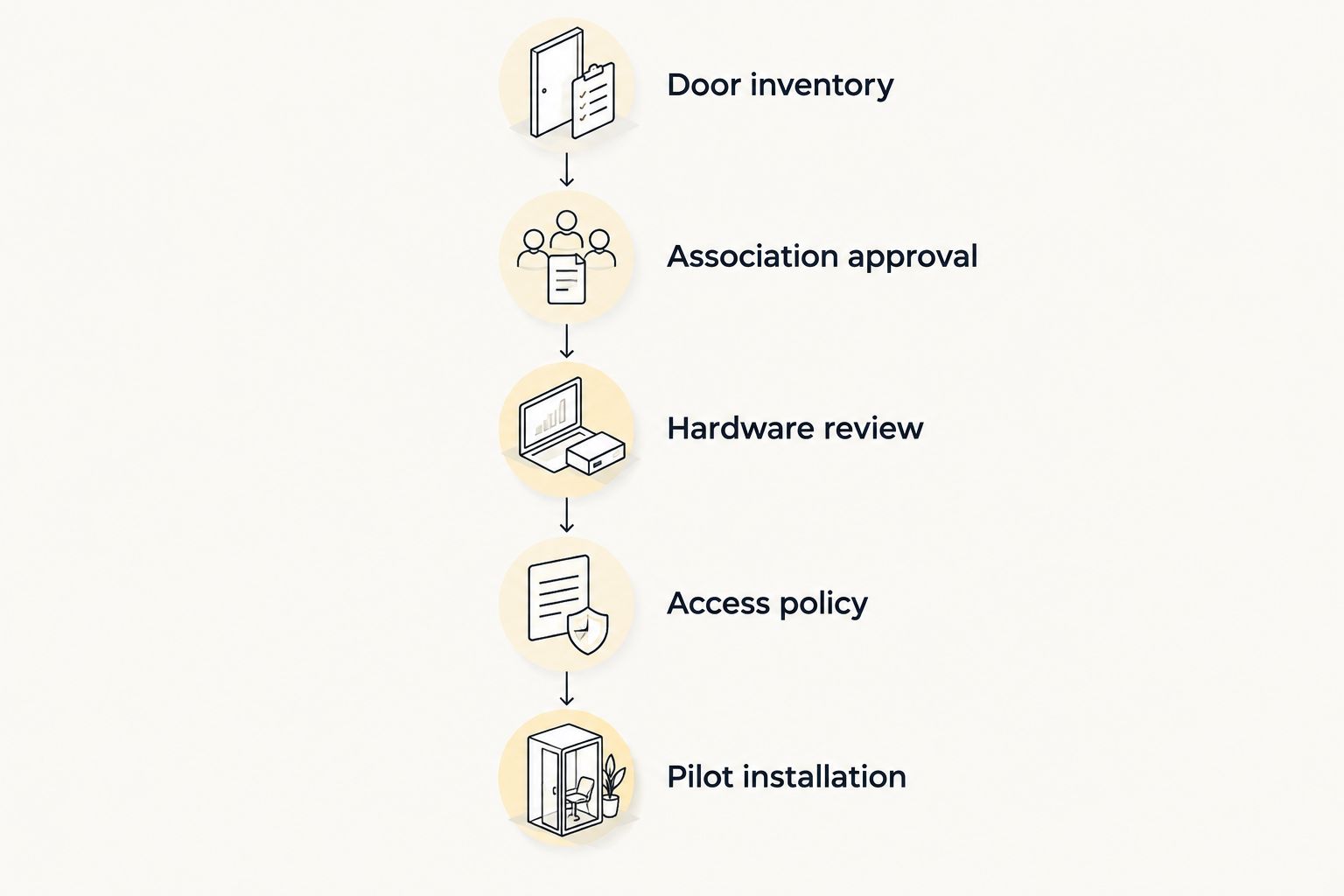
During the pilot, check normal locking and unlocking, closure, credential removal, and the documented recovery method. Confirm remote functions separately from local entry. An app demonstration with the door open does not prove that the installed door closes and locks correctly.
For rated doors, request documentation that supports the proposed modification and consult the responsible building or fire authority where required. Do not assume that retaining the original door makes every hardware alteration acceptable.
How these options were ranked
The ranking prioritizes distinct buying decisions: resident administration, keyed versus key-free entry, exterior preservation, managed unit access, and shared-door systems. It does not claim laboratory testing, measured battery endurance, or a security ranking across these products.
Physical compatibility, association permission, and a workable recovery plan are required before any recommendation applies. Manufacturer instructions for the exact model take precedence over a category-level comparison.
Which smart lock should your community choose?
Choose Schlage Encode as the default shortlist for an approved, resident-managed condo deadbolt. Choose Yale Assure Lock 2 when the keyed-versus-key-free decision comes first, or August Wi-Fi Smart Lock when compatible exterior hardware must remain.
For association-managed access, move to a system discussion: Schlage Control for unit entries and SALTO XS4 for shared-door projects. Do not choose a community system solely because its resident app looks convenient.
GO Locksmith is a mobile locksmith option for Fort Myers-area residents and associations needing confirmed lock services. Call (239) 412-1101 to discuss the door, requested work, and current availability. Hours are Sunday–Thursday, 7:00 AM–11:00 PM; Friday, 7:00 AM–5:00 PM; Saturday closed.
FAQ
What's the best smart lock for a condo unit?
Schlage Encode is the default shortlist here for an approved, resident-managed condo deadbolt. Yale Assure Lock 2 suits configuration choices, while August Wi-Fi Smart Lock suits compatible installations that retain exterior hardware.
Can my HOA stop me from installing a smart lock?
Your association's governing documents and applicable law determine approval requirements. Check ownership and alteration rules before replacing exterior hardware or modifying the door.
Is a retrofit smart lock better for a condo door?
A retrofit smart lock is useful when you need to retain compatible exterior hardware. It does not eliminate association approval, repair worn hardware, or fit every existing lock.
Can one smart lock system manage unit doors and common entrances?
A managed access system can support multiple door applications when the selected components are designed for them. Confirm each door's hardware, administrator permissions, and credential requirements rather than assuming one residential model fits throughout.
Do smart locks work when the internet is down?
Local entry and remote functions must be checked separately for the exact model. An internet outage does not necessarily disable local unlocking, but remote commands depend on the system's connectivity requirements.
Can I install a smart lock on a fire-rated condo door?
Only choose modifications supported for the specific rated door assembly and applicable requirements. Obtain the relevant documentation and approval before drilling or replacing hardware.
Does GO Locksmith provide around-the-clock service?
GO Locksmith is not a 24/7 service. Its hours are Sunday–Thursday, 7:00 AM–11:00 PM, and Friday, 7:00 AM–5:00 PM; Saturday is closed. Call (239) 412-1101 to check current availability.
One last thing
Removing an app credential does not cancel a physical key. If the chosen lock retains a key cylinder, your move-out policy must address both access methods. Document who holds keys, who can administer credentials, and when rekeying or another access change is required.