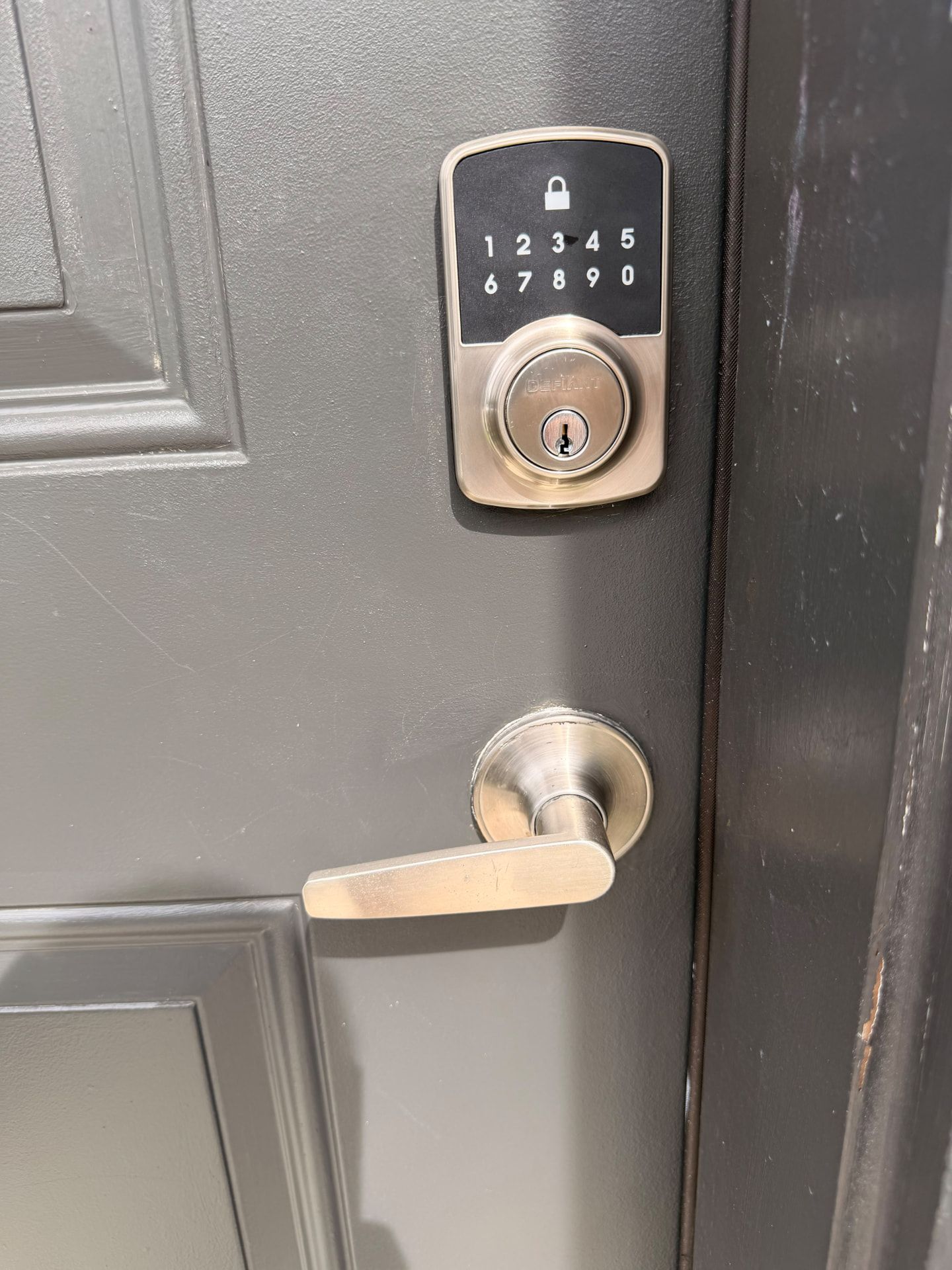
The easiest smart lock to install is the one that matches your existing door and lock preparation without unsupported alterations. On a compatible, freely operating deadbolt, an interior retrofit can involve less physical replacement; a complete smart deadbolt can be straightforward when the door matches its requirements. Neither format is universally easier, and no installation-time ranking is established here.
- Rank smart locks by the work your door requires, not an advertised installation time.
- A retrofit is a candidate only when the existing deadbolt is explicitly supported.
- A matching replacement can be easier than adapting incompatible old hardware.
- Separate door installation, device setup, and guest-access testing.
What makes an installation genuinely simple?
A manageable installation has a clear hardware fit, appropriate permissions, and a lock that operates normally before electronic features are added. The Florida smart-lock guide discusses everyday entry choices; this ranking focuses instead on how much preparation and adaptation your door needs.
Evaluate:
- Existing mechanism: Does it move without force?
- Published compatibility: Does the retrofit or replacement explicitly fit?
- Door preparation: Do dimensions match the installation instructions?
- Clearance: Can the interior unit operate without hitting another handle or trim?
- Restrictions: Is the alteration permitted for this door and property?
- Setup requirements: Is account, network, or accessory configuration part of the work?
A screwdriver-only claim does not prove a door is ready. Incorrect preparation or a binding bolt can turn a simple-looking product into the wrong choice.
Installation routes ranked by preparation required
These positions describe favorable starting conditions, not measured product-test results. A route moves out of the easy category when its required conditions are absent.
| Route | Best for | Physical-work advantage | Main limitation |
|---|---|---|---|
| Supported interior retrofit on a sound deadbolt | Retaining compatible exterior hardware | Less exterior hardware replacement | Exact deadbolt and adapter support are essential |
| Complete replacement matching existing preparation | A door already meeting the new model's specifications | A defined assembly and installation process | Measurements and strike fit still need checking |
| Replacement requiring new preparation or repairs | A door that needs a different arrangement | Can address an unsuitable existing setup | Not an easy swap; assess the door first |
1. A supported retrofit: easier only when the existing lock qualifies
A retrofit replaces or attaches to compatible interior components while retaining appropriate exterior hardware. It can suit an owner who wants to preserve the outside appearance or current physical-key arrangement.
The benefit is less exterior replacement. The drawback is dependence on the existing mechanism: a worn or unsupported deadbolt is not made suitable by adding a motor.
Read the exact model's compatibility guidance before removing anything. August's support material, for example, provides deadbolt compatibility information and explains that suitable retrofit installations can retain the original key. That does not establish compatibility for every model sold under the smart-lock label.
If guest keypad entry is required, check the keypad as another component. Mounting, pairing, and testing it adds work even if the interior retrofit is physically straightforward.
2. A matching replacement: a clearer job than an uncertain adaptation
Replacing a complete assembly can be the more manageable route when its documented dimensions match the door and the old hardware should not be retained.
Its advantage is working from one product's defined installation process. The limitation is that the frame and door still need to accept the bolt correctly.
Check door thickness, backset, holes, orientation, and interior clearance against the specific manual. Schlage's published preparation instructions demonstrate that a mismatch prevents proper fit; they are not permission to assume every smart deadbolt uses identical measurements.
A replacement that fits is preferable to a retrofit that only nearly fits. Do not improvise an adapter or leave hardware loose to compensate for incompatibility.
3. New preparation or a faulty door: assess before buying
When the door has no suitable preparation, has rated-assembly restrictions, or requires mechanical correction, the job is not simply a smart-lock swap.
The advantage of a planned installation is addressing the real entrance rather than forcing a purchased product onto it. Its limitation is additional assessment and appropriate door work, which must be defined before approval.
Do not drill a rated or association-controlled door based on a generic tutorial. Confirm the permitted hardware and alteration process with the relevant documentation and authorized decision-maker.
Physical fit is only the first completion test
After the mechanism is fitted, follow the model's documented setup. Code creation, connection, and calibration differ by product.
Keep a safe alternative entry method during testing. Verify manual operation and the included electronic entry method before relying on remote features.
Separate these outcomes:
- The lock is correctly secured to the door.
- The bolt operates normally with the door open and closed.
- The user's intended entry method works.
- Administrative access is controlled by the right person.
- The documented fallback method is understood.
A phone notification is not proof that a bolt fully engaged. Check physical operation as well as the app's indication.
When to ask for an installation assessment
Provide photos, model details, and any door symptoms. Explain whether you are keeping exterior hardware, changing keys, or introducing code entry for the first time.
GO Locksmith's lock installation page provides a contact route for discussing fresh installation. Confirm support for the chosen hardware and the work included; no universal product compatibility or setup service is promised by this comparison.
Pricing depends on the actual job. Call (239) 412-1101 for an estimate instead of choosing hardware based on an assumed labor time.
FAQ
Which smart lock is easiest to install?
The easiest candidate is one that fits the existing preparation and meets your requirements. A supported retrofit and a matching replacement are different routes, not universal winners.
Is a retrofit always easier than a new deadbolt?
No. Incompatible or damaged existing hardware can make a retrofit unsuitable, while a matching replacement can have a clearer installation path.
Can I choose by a claimed installation time?
Do not use an advertised time as proof of fit. Assess your actual door and the work needed.
Will a smart lock fix a bolt that sticks?
No. Have the mechanical resistance assessed before expecting electronic operation to work correctly.
Does successful app setup prove installation is finished?
No. Test physical bolt operation, door closure, and the intended entry method as well.
Can GO Locksmith install my chosen model?
Call with the exact model and door information to confirm the job. Fresh installation does not imply support for every smart-lock product.
Choose the installation route before the device
For a Fort Myers or Southwest Florida property, discuss the existing entrance with GO Locksmith at (239) 412-1101. Ask which parts can remain, whether the door needs other work, and what will be tested before handover.
Business hours are Sunday–Thursday 7:00 AM–11:00 PM and Friday 7:00 AM–5:00 PM. Saturday is closed.