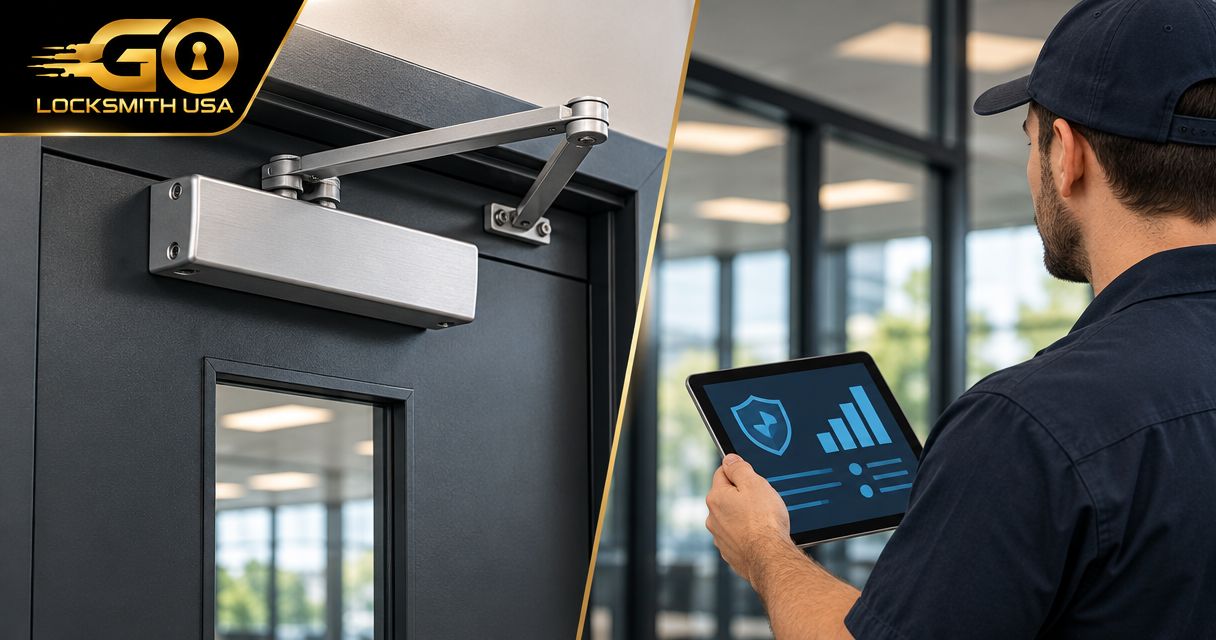
Best default for a heavy-use opening: LCN 4040XP. Best for a conventional commercial retrofit: Norton 7500 Series. Best for institutional openings: SARGENT 281 Series. Best for a slide-track application: dormakaba TS 93. This 2026 shortlist ranks buying choices by construction, application fit, and maintenance considerations—not a claimed number of years before failure.
- Best commercial door closers ranked by durability: start with LCN 4040XP for a heavy-use opening.
- Norton 7500 Series and SARGENT 281 Series deserve consideration when the existing mounting and application match.
- Choose dormakaba TS 93 when a slide-track configuration suits the door, not simply for its appearance.
- GO Locksmith provides commercial door closer service in Fort Myers; call to discuss your specific opening.
Why the door matters as much as the closer
A durable closer cannot compensate for a door that drags, a loose frame, or a latch that requires excessive force. Repeatedly increasing spring power to overcome those problems makes the door harder to open without fixing the underlying fault.
Start with the complete opening: door, hinges, frame, closer, and latch. GO Locksmith is a mobile locksmith service offering commercial door closer and push bar service in Fort Myers and other confirmed Southwest Florida service areas.
A closer controls movement; a lock controls access. If you are reviewing both, the guide to commercial door locks for retail storefronts addresses the locking side of the opening.
What makes a durable commercial door closer?
Use these criteria before comparing model names:
- Commercial duty classification: Look for documented ANSI/BHMA performance information for the exact model. A grade is useful evidence, not a promise of service life.
- Body and mechanism: Check the housing, arm, mounting hardware, and hydraulic mechanism together. A substantial closer body still depends on secure attachment.
- Application fit: Match the closer to the door's width, weight, location, and required mounting arrangement. A recognized model in the wrong application is still the wrong choice.
- Controlled movement: Closing speed, latch speed, and backcheck address different parts of door movement. Adjustability helps only when the hardware is installed and set correctly.
- Service documentation: Clear installation instructions and identifiable parts make maintenance decisions easier. Record the full model and arm configuration.
- Opening requirements: Accessibility, fire-door requirements, and egress conditions take priority over appearance or a preference for stronger closing force.
Choose the closer that fits the opening before choosing the closer with the strongest reputation. Durability is a system outcome, not just a label on the cover.
Commercial door closers at a glance
The order below is a practical buying shortlist, not a laboratory lifespan ranking. Manufacturer technical literature from LCN, Norton, SARGENT, and dormakaba describes these product families; confirm the exact configuration against its installation instructions before ordering.
| Rank and closer | Best for | Relevant design feature | Key limitation |
|---|---|---|---|
| 1. LCN 4040XP | Heavy-use commercial openings | Cast-iron body and adjustable commercial closer design | Requires the correct arm, mounting arrangement, and clearance |
| 2. Norton 7500 Series | Conventional surface-mounted retrofits | Commercial rack-and-pinion closer with multiple mounting options | The series name alone does not establish a retrofit match |
| 3. SARGENT 281 Series | Institutional openings with defined hardware specifications | Cast-iron commercial closer construction | Must match the opening's specified configuration |
| 4. dormakaba TS 93 | Openings suited to a slide track | Cam-action mechanism with slide-track configuration | Track geometry and clearance require careful checking |
No model here receives a corrosion, compatibility, or lifespan guarantee. For an exterior opening, check the manufacturer's documentation for the proposed finish and application rather than assuming that an indoor specification covers weather exposure.
1. LCN 4040XP: best for heavy-use commercial openings
The LCN 4040XP is a surface-mounted commercial closer with a cast-iron body. It belongs on the shortlist when your priority is a substantial closer for a frequently used opening, provided the door and mounting arrangement meet the manufacturer's requirements.
Its recommendation rests on its documented construction and application options—not evidence that it outlasts every competing model. Check the full assembly, including the arm and frame attachment, rather than treating the closer body as the entire purchase.
LCN 4040XP pros:
- Cast-iron construction provides a clear, documented basis for considering it for demanding use.
- Adjustable operation allows the installed closer to be set for the opening.
- Published mounting instructions help establish the required geometry and clearances.
LCN 4040XP cons:
- The correct arm and mounting configuration still need to be selected.
- Strong closing force does not correct hinge, frame, or latch defects.
- Existing screw holes do not automatically establish compatibility.
Best for: A business specifying a heavy-use closer after checking the complete opening.
Verdict: Buy the LCN 4040XP when the application matches; do not order it solely because it leads this shortlist.
2. Norton 7500 Series: best for a conventional retrofit
The Norton 7500 Series is a commercial surface-mounted rack-and-pinion closer family. Consider it when replacing a conventional closer and evaluating whether the manufacturer's mounting options fit your door and frame.
Retrofit suitability needs more than a similar-looking cover. Compare the existing hole pattern, arm arrangement, frame dimensions, and opening clearance with the instructions for the exact replacement.
Norton 7500 Series pros:
- Its conventional surface-mounted format suits a familiar commercial hardware layout.
- Multiple mounting options support application-specific selection.
- Published technical instructions provide a basis for checking the replacement assembly.
Norton 7500 Series cons:
- A product-family name is not enough to confirm a direct replacement.
- Existing damaged attachment points need attention before installation.
- A different arm configuration changes the mounting requirements.
Best for: A conventional commercial opening where retrofit fit can be verified before purchase.
Verdict: Buy the Norton 7500 Series for a documented fit; hold the purchase if the existing mounting details are unclear.
3. SARGENT 281 Series: best for institutional specifications
The SARGENT 281 Series is a commercial closer family with cast-iron construction. It is a useful candidate for institutional openings where the closer must follow an established hardware specification rather than a casual replacement choice.
For a school, office, or similar facility, the closer decision belongs alongside door handing, arm selection, mounting details, and any fire-door requirements. Matching the written specification matters more than choosing a product with a familiar brand name.
SARGENT 281 Series pros:
- Cast-iron construction makes it relevant to a durability-focused shortlist.
- Manufacturer documentation supports configuration-specific selection.
- An identifiable product family helps facilities record the installed hardware accurately.
SARGENT 281 Series cons:
- Similar appearance does not establish equivalence with existing hardware.
- Institutional specifications require checking the exact configuration, not just the series.
- The closer cannot resolve a damaged or misaligned opening.
Best for: A facility replacing or specifying hardware against documented opening requirements.
Verdict: Buy the SARGENT 281 Series when it matches the specification; hold if the required assembly has not been identified.
4. dormakaba TS 93: best for a slide-track application
The dormakaba TS 93 uses a cam-action mechanism and slide-track arrangement. It addresses a different selection need from a conventional projecting-arm closer: an opening where the track configuration is appropriate.
A track is not evidence of greater durability by itself. Choose this design because its operating characteristics and mounting arrangement fit the opening, then verify the exact version and installation requirements.
dormakaba TS 93 pros:
- The slide-track arrangement provides an alternative to a conventional projecting arm.
- Cam-action operation makes it a distinct option within this comparison.
- Manufacturer instructions establish the geometry needed for correct installation.
dormakaba TS 93 cons:
- Track clearance and mounting geometry need specific checking.
- A conventional arm closer is not automatically interchangeable with this design.
- Appearance alone does not justify selecting it for a demanding opening.
Best for: An opening deliberately specified for a compatible slide-track closer.
Verdict: Buy the dormakaba TS 93 for a verified track application; skip it as an appearance-only substitution.
How this durability shortlist is ranked
LCN 4040XP takes the default position because its cast-iron commercial design makes it a clear starting point for a heavy-use opening. Norton 7500 Series follows for conventional retrofit evaluation; SARGENT 281 Series serves specification-led institutional selection; dormakaba TS 93 addresses slide-track applications.
The ranking uses the criteria above: documented construction, mounting fit, movement control, and service information. It does not claim that one model lasts longer than another under identical testing. Installation quality, door condition, exposure, and use all affect the result.
Check the opening before replacing the closer
Use this sequence to separate a closer problem from an opening problem. You do not need to dismantle the closer to collect useful information.
- Door condition: Note dragging, visible damage, hinge movement, or contact with the frame.
- Mounting fit: Photograph the closer label, arm, attachment points, and the surrounding frame.
- Closing behavior: Describe whether the door slams, stops short, rebounds, or fails to latch.
- Opening requirements: Identify whether the door is fire-rated, serves an accessible route, or carries exit hardware.
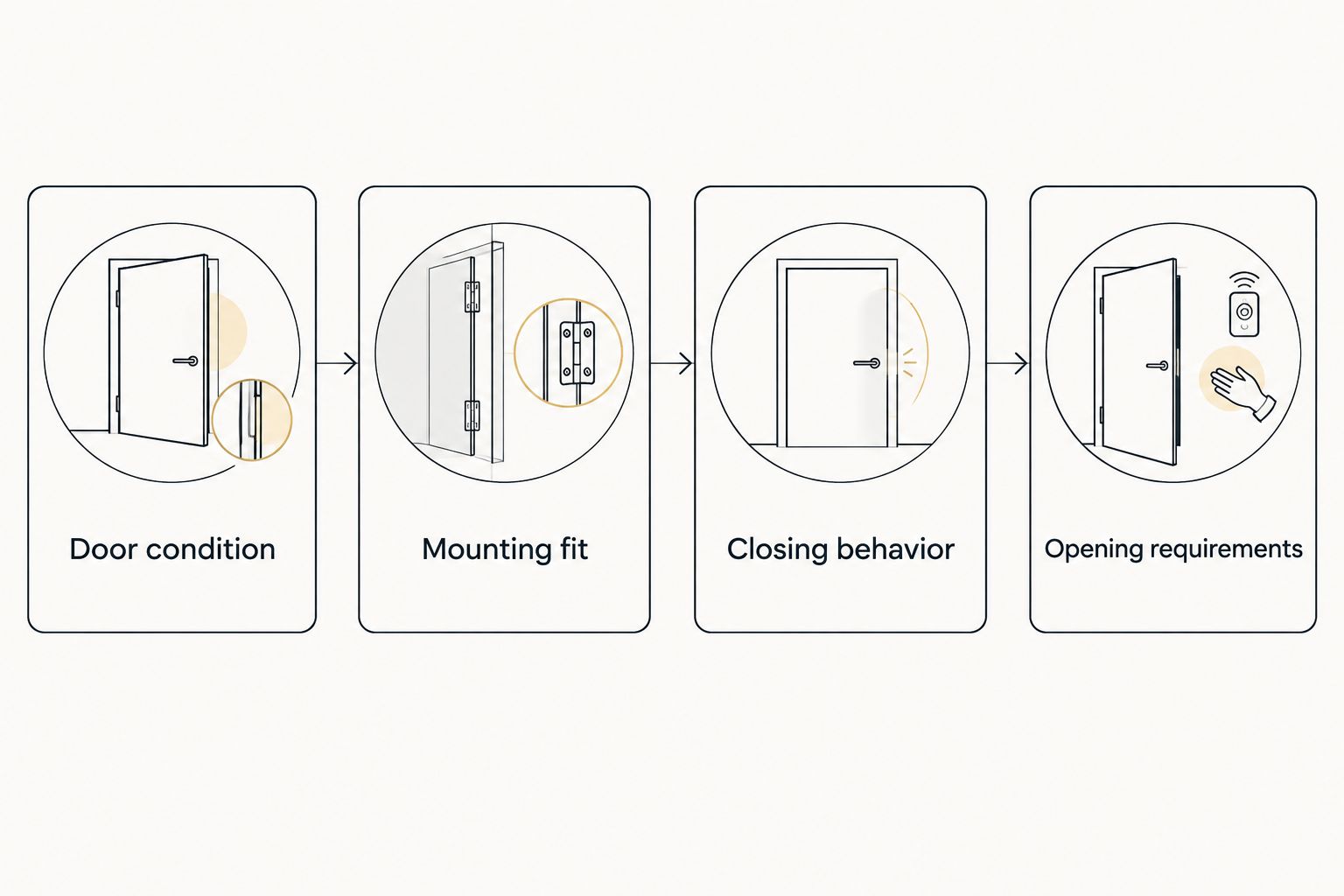
Give these observations to the service provider before selecting hardware. An old model number helps, but photographs and a clear description of the fault provide the context needed to discuss the job.
Visible hydraulic leakage, loose attachment points, and repeated failure to latch need attention. Do not keep turning adjustment valves without the exact instructions; incorrect adjustment can damage the closer or leave the door operating unsafely.
Durability must not make the door harder to use
More closing force is not automatically better. A door must close and latch as required while meeting the opening's applicable accessibility and safety requirements.
The U.S. Access Board's ADA Accessibility Standards specify a maximum opening force of 5 pounds for covered interior hinged doors, excluding fire doors. The same standards require a door closer to take at least 5 seconds to move from 90 degrees open to 12 degrees from the latch.
Those are specific requirements with defined scope, not universal settings for every exterior or fire-rated opening. Have the installed assembly assessed against the rules that actually apply to the door.
Backcheck slows movement near the open end of travel; it is not a substitute for a proper door stop. Likewise, a fire door should not be held open with a wedge. Hold-open arrangements require a configuration appropriate to the fire-door assembly and applicable requirements.
Which commercial door closer should you choose?
Start with LCN 4040XP for a heavy-use opening, then verify fit. Choose Norton 7500 Series when a conventional retrofit is the main concern, SARGENT 281 Series when the written hardware specification controls the decision, and dormakaba TS 93 when a slide-track arrangement is appropriate.
For commercial door closer service in Fort Myers, GO Locksmith is a service option—not a closer manufacturer or a claim that every listed model suits your door. Call (239) 412-1101 to discuss the opening, request a job-specific estimate, and check current availability.
Service hours are Sunday–Thursday, 7:00 AM–11:00 PM, and Friday, 7:00 AM–5:00 PM. Saturday is closed.
FAQ
What's the best commercial door closer for durability?
LCN 4040XP is the default recommendation in this shortlist for a heavy-use commercial opening. Its cast-iron construction supports consideration, but the exact arm, mounting arrangement, and door requirements must match.
Is LCN 4040XP more durable than Norton 7500 Series?
This guide does not establish that LCN 4040XP outlasts Norton 7500 Series. It recommends LCN as a heavy-use starting point and Norton for conventional retrofit evaluation, with application fit deciding the final choice.
Does a Grade 1 closer guarantee years of service?
No. A documented ANSI/BHMA grade describes performance against a standard, not a guaranteed lifespan on your door. Installation, door condition, use, and exposure still matter.
Can I replace a commercial door closer with any similar model?
No. Check the mounting pattern, arm configuration, clearances, door characteristics, and opening requirements before selecting a replacement. Similar covers do not prove compatibility.
Why does my commercial door slam even with a closer?
Slamming can result from incorrect settings, closer faults, or problems elsewhere in the opening. The door, arm attachment, latch, and closer need assessment rather than repeated blind adjustment.
Is a stronger closer better for a heavy door?
Not automatically. The closer must be correctly sized and configured while meeting applicable opening-force and closing requirements. Extra spring force does not repair dragging hinges or a misaligned latch.
Can GO Locksmith help with a commercial door closer in Fort Myers?
Yes. GO Locksmith lists commercial door closer service and serves Fort Myers. Call (239) 412-1101 to discuss your door and check current availability during confirmed business hours.
One last thing
Photograph the arm as well as the closer body. The label identifies the product family, but the arm and frame photographs show the mounting context that a model name alone leaves out. Keep those images with your building's hardware records for the next service call.