Best overall: a single-cylinder mechanical deadbolt that matches your door’s approved hardware. Best for an existing impact-rated entry: the manufacturer-specified multipoint locking system. Best for code-based access: a compatible keypad deadbolt. Best for a directly exposed coastal entrance: a deadbolt with documented corrosion resistance. The best deadbolt locks for hurricane prone homes in 2026 fit the approved door assembly; a stronger-looking lock alone does not establish hurricane protection.
- The best deadbolt locks for hurricane prone homes match the approved door assembly, not a hurricane-themed product claim.
- Choose a single-cylinder mechanical deadbolt for straightforward operation without batteries or an app.
- Keep manufacturer-specified multipoint hardware on impact-rated doors unless the approval permits a replacement.
- Golocksmithusa provides home locksmith services and smart lock installation in Fort Myers and Southwest Florida.
Why this matters
A deadbolt secures the door at its locking point. Hurricane performance depends on the door, frame, glazing where present, hinges, hardware, and installation working as an assembly. Burglary resistance and wind resistance are different requirements. Neither proves the other.
For your 2026 hardware replacement, start with the door’s identification label and installation documents. Find the approved configuration before choosing a lock. Golocksmithusa provides residential locksmith services and smart lock installation across Fort Myers and Southwest Florida.
Choose the lock around the door’s requirements—not the door’s storm protection around a lock advertisement. If the opening has damage or an unresolved approval question, settle that before treating a new deadbolt as the solution.
What makes the best deadbolt for a hurricane-prone home
Use these criteria to screen your 2026 shortlist before comparing finishes or connected features:
- Approved hardware compatibility: Check whether the door’s approval or manufacturer instructions identify a particular lock, latch, strike, or multipoint system. A replacement must follow those requirements.
- Mechanical fit: Match the bore preparation, door thickness, backset, strike location, and handing where applicable. The bolt must extend fully without lifting, pushing, or pulling the door into position.
- Documented security rating: Look for independently certified security information for the exact model. An ANSI/BHMA security grade concerns lock performance; it is not a hurricane approval for the entrance.
- Exposure suitability: Check the manufacturer’s outdoor-use instructions, corrosion information, and maintenance requirements. A finish name or coastal-themed description is not proof of corrosion performance.
- Safe exit and maintenance: Choose an inside release appropriate for the opening and applicable code. Consider battery replacement, key control, and whether household members can operate the lock easily.
A commonly listed 1-inch bolt throw describes the bolt’s travel, not the door’s wind rating. Likewise, 2-3/8-inch and 2-3/4-inch backsets describe common distances from the door edge to the center of the lock bore. These measurements help you check fit; none establishes storm suitability.
Deadbolt options at a glance for 2026
These are hardware types, not tested product rankings. The right choice depends on the existing entrance and its documented requirements.
| Rank and option | Best for | Standout feature | Key limitation |
|---|---|---|---|
| Single-cylinder mechanical deadbolt | Straightforward everyday locking | Exterior key and interior thumbturn | Secures one locking point; does not establish hurricane performance |
| Manufacturer-specified multipoint system | Preserving an impact-rated door configuration | Operates the locking points designed for that door | Requires system-specific compatible parts |
| Compatible keypad deadbolt | Households that want code-based entry | Exterior entry without distributing a physical key for every user | Electronic operation adds maintenance and compatibility checks |
| Documented corrosion-resistant deadbolt | Entrances exposed to coastal weather | Exposure suitability supported by model documentation | Corrosion resistance is separate from security and wind resistance |
The categories overlap. A keypad deadbolt can also carry corrosion documentation, and a mechanical deadbolt can be part of an approved impact-rated assembly. Read the ranking as a decision tree: preserve required hardware first, then select the access method and exposure suitability.
1. Single-cylinder mechanical deadbolt: best for simple operation
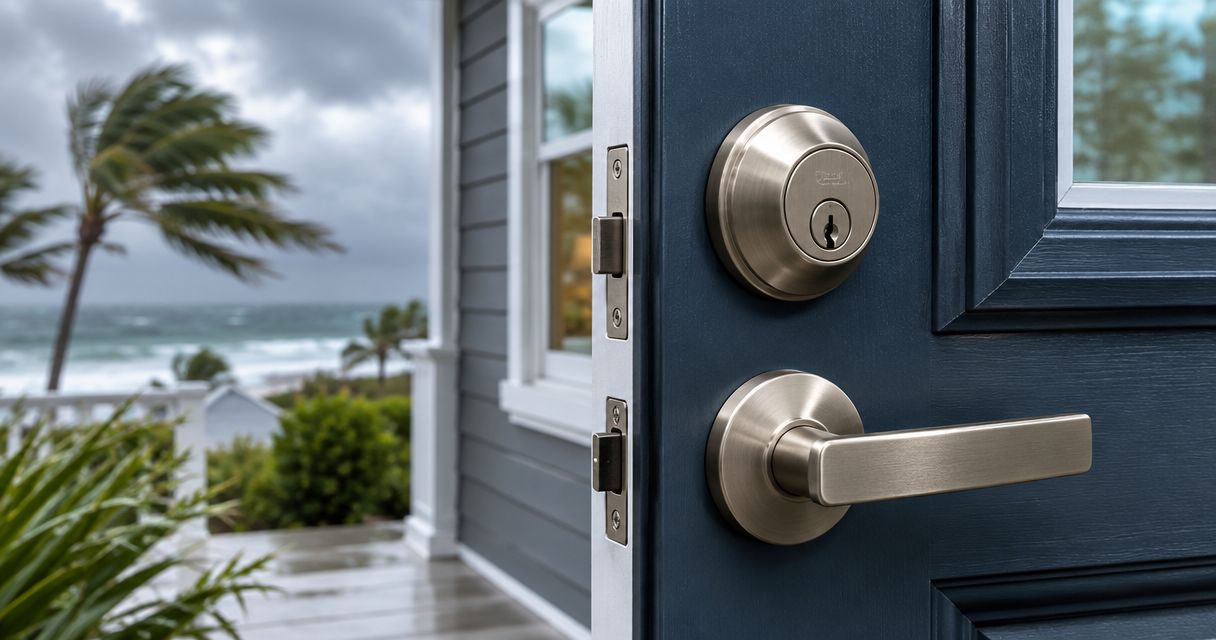
A single-cylinder mechanical deadbolt uses a key outside and a thumbturn inside. It does not need batteries, a phone, or a network connection to operate. That makes it the default choice when you want straightforward locking and your door permits this hardware type.
Best for: Homeowners replacing a conventional deadbolt on a compatible door without adding electronic access.
Look beyond the faceplate. Check the exact model’s security certification, supplied strike, installation instructions, and outdoor-use guidance. An impressive lock body cannot correct a loose frame or a bolt that only partially enters the strike.
Single-cylinder mechanical deadbolt pros:
- Mechanical operation does not depend on battery condition.
- An interior thumbturn provides an uncomplicated release.
- Model-specific certifications let you compare documented security performance.
Single-cylinder mechanical deadbolt cons:
- Physical keys require a plan for lost, copied, or unreturned keys.
- One deadbolt does not substitute for a required multipoint system.
- The thumbturn’s suitability depends on the opening and applicable requirements.
Ask the installer to demonstrate full bolt movement with the door both open and closed. Operation that is easy with the door open but stiff when closed points to an alignment problem, not proof that you need a different access technology.
Verdict: Buy a compatible single-cylinder mechanical deadbolt for uncomplicated daily use; do not buy it as a standalone hurricane upgrade.
2. Manufacturer-specified multipoint system: best for rated doors
A multipoint locking system engages locking points at different positions along the door. It belongs on this list because some entrances use an integrated system rather than a standalone deadbolt. Replacing that system with a conventional lock changes the hardware arrangement.
Best for: Homeowners maintaining an impact-rated door that already requires specified multipoint hardware.
Find the door manufacturer, model identification, and applicable approval documents before ordering replacement parts. Match the complete system requirements, not just the visible handle. Similar-looking components are not evidence of interchangeability.
Manufacturer-specified multipoint system pros:
- Preserves the intended hardware configuration when the correct replacement is used.
- Operates the locking points built into the door’s design.
- Keeps the selection tied to door-specific documentation rather than a generic lock claim.
Manufacturer-specified multipoint system cons:
- Replacement parts are system-specific.
- Door alignment affects whether all required locking points engage.
- Adding an unrelated standalone deadbolt is not automatically an approved modification.
An impact-rated label does not mean every later hardware change is acceptable. Check what the approval actually covers and follow the manufacturer’s installation requirements. If the door needs handle movement before locking, learn and use that sequence rather than assuming it locks like a conventional deadbolt.
Verdict: Buy the specified compatible replacement when the existing door requires multipoint hardware; skip an improvised conversion.
3. Compatible keypad deadbolt: best for code-based household entry
A keypad deadbolt lets authorized users enter a code instead of using a physical key for each entry. Features differ by model, so verify how codes are created, removed, and retained. Do not assume that every keypad lock includes remote control, a key override, or the same power-failure behavior.
Best for: Households that want code-based access and can keep up with the selected model’s maintenance requirements.
The useful question is whether the keypad solves your access problem without conflicting with the door’s requirements. Golocksmithusa offers smart lock installation; confirm the chosen hardware’s compatibility before changing an existing entrance.
Compatible keypad deadbolt pros:
- Code-based entry reduces the need to hand every user a physical key.
- Models with individual codes support separate access credentials.
- A keypad provides an access option for households that prefer entering a code.
Compatible keypad deadbolt cons:
- Electronic operation adds battery and maintenance requirements.
- Weather suitability and backup entry vary by model.
- Connected features do not establish wind, impact, or corrosion performance.
For a 2026 purchase, read the manual’s low-battery procedure and backup-entry instructions before installation. Keep the backup method accessible without depending on the locked entrance. If the lock offers remote features, distinguish those features from the way the lock operates locally.
Verdict: Buy a compatible keypad deadbolt for code-based access; skip it if you cannot maintain its power source and backup-entry plan.
4. Documented corrosion-resistant deadbolt: best for exposed entries
A deadbolt with documented corrosion resistance addresses exposure, not hurricane certification. This category is relevant when the entrance receives salt exposure, wind-driven rain, or persistent moisture. Judge the exact model’s documentation rather than relying on its color or finish name.
Best for: Homeowners selecting hardware for an exposed coastal entrance after confirming door compatibility.
Check both sides of the lock. Manufacturer guidance can distinguish between an exterior component and an interior component that needs protection. Also check maintenance instructions and whether the complete installation location meets the stated conditions.
Documented corrosion-resistant deadbolt pros:
- Gives you an exposure-related criterion to compare across exact models.
- Directs attention to maintenance and installation conditions before purchase.
- Can be combined with either mechanical or electronic access when documented for that model.
Documented corrosion-resistant deadbolt cons:
- Corrosion documentation does not establish burglary or hurricane resistance.
- Suitable hardware still requires maintenance according to its instructions.
- A suitable exterior finish does not prove every component tolerates direct exposure.
Inspect the surrounding opening as well as the lock. A deadbolt replacement does not repair water entry, deteriorated framing, or a damaged threshold. Those are separate entrance problems that need their own correction.
Verdict: Buy based on documented exposure suitability; skip coastal-themed claims that provide no model-specific support.
Check the entrance before ordering hardware
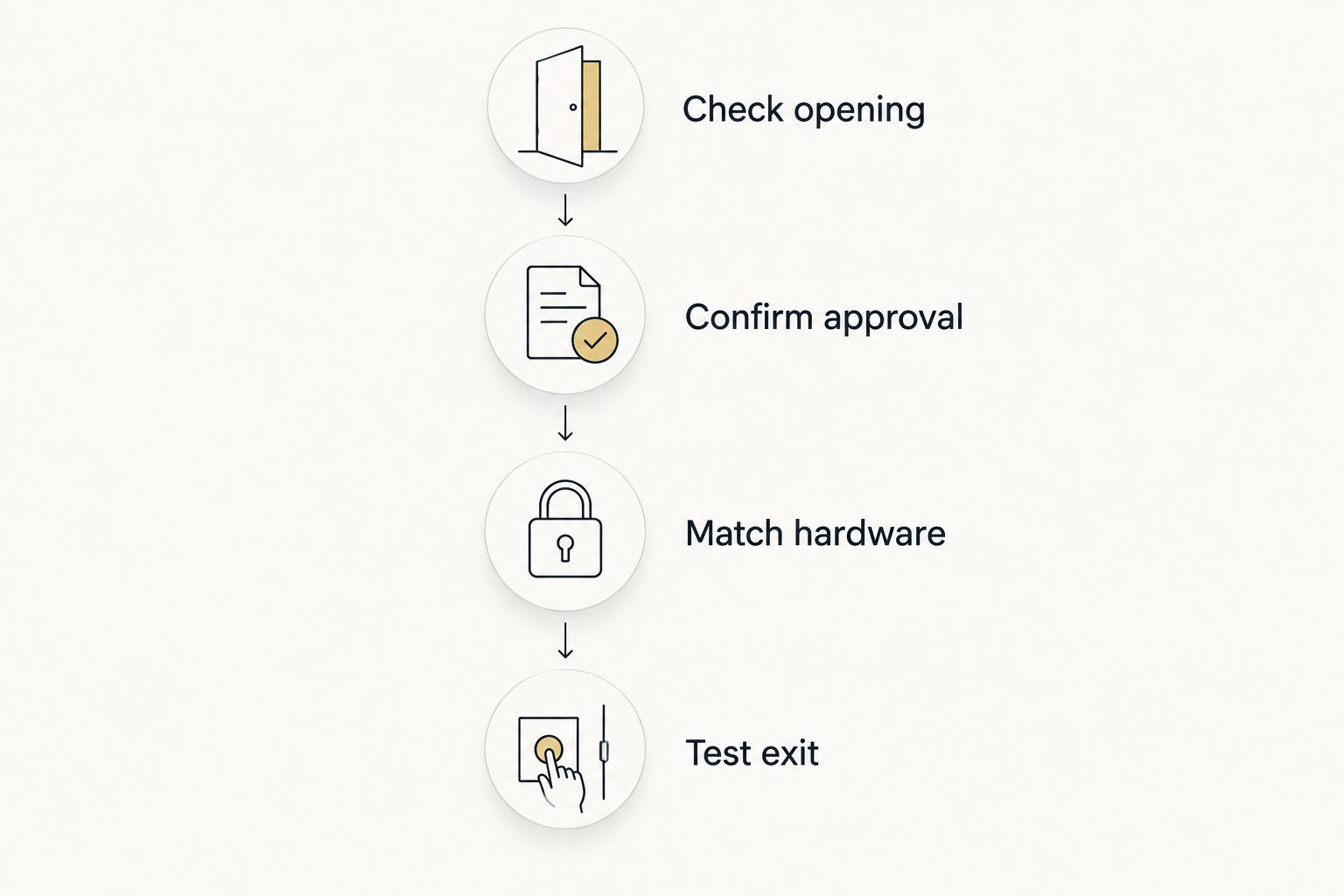
Use this sequence to separate a lock replacement from a door-system problem. You do not need to diagnose the whole entrance yourself, but you do need the right information before authorizing a change.
- Check opening: Note door damage, loose hardware, binding, and whether the existing bolt extends fully. Do not force a stiff lock or repeatedly slam the door to make it latch.
- Confirm approval: Locate the door identification and relevant manufacturer documents. Establish whether a specific lock or multipoint configuration is required.
- Match hardware: Record the existing preparation and compare it with the exact replacement’s installation instructions. Resolve compatibility before drilling or enlarging openings.
- Test exit: After installation, check entry, locking, and inside release. Follow the required locking sequence and confirm that household members understand it.
If the door binds, identify the cause before installing an electronic lock to work around it. The bolt still needs a clear path into the strike. Fix alignment before adding access features.
Plan your home lock replacement
Review your entrance needs with Golocksmithusa before choosing replacement hardware.
How these options were ranked
The 2026 ranking puts approved compatibility ahead of convenience. A single-cylinder mechanical deadbolt is the default for simple operation, but manufacturer-specified multipoint hardware takes priority whenever the existing door requires it.
Keypad access earns a separate recommendation because it changes how people enter. Documented corrosion resistance earns another because it addresses exposure. Neither feature removes the need to check fit, security certification, safe exit, and the door assembly’s requirements.
These recommendations do not name a universal winning model. A model that fits one entrance can be unsuitable for another. The ranking identifies the hardware type to investigate, then gives you the checks that determine whether it belongs on your door.
Which deadbolt should you choose?
Choose a compatible single-cylinder mechanical deadbolt unless your entrance requires multipoint hardware or your household specifically needs keypad access. For an exposed entrance, add documented corrosion suitability to whichever compatible type you select.
Golocksmithusa is a home locksmith service for Fort Myers and Southwest Florida residents who need lock replacement or smart lock installation. Keep the service decision separate from the approval decision: the hardware must still match the door’s documented requirements.
For your 2026 replacement, write down the door identification, existing lock type, exposure conditions, and preferred entry method. That short brief is more useful than asking for the strongest deadbolt without describing the entrance.
FAQ
What's the best deadbolt for a hurricane-prone home?
The best deadbolt is one that matches the door’s approved hardware requirements and your access needs. A single-cylinder mechanical deadbolt is a straightforward default when the door permits it; preserve specified multipoint hardware when required.
Does a Grade 1 deadbolt make my door hurricane-rated?
No. A lock’s security grade does not establish the hurricane performance of the complete entrance. Check the door assembly’s applicable approval and installation requirements.
Is a smart deadbolt better than a mechanical deadbolt during a hurricane?
Smart features do not establish better hurricane resistance. Choose electronic access for its entry functions, then separately verify door compatibility, exposure suitability, power requirements, and backup entry.
Can I replace a multipoint lock with a regular deadbolt?
Do not make that change without confirming that the door’s requirements permit it. Match the manufacturer-specified hardware and check the applicable approval before modifying the door.
How much does a suitable deadbolt installation cost?
Get a quote for the exact hardware and entrance work. Describe the existing lock, door preparation, alignment issues, and any required multipoint system so the scope is clear.
Should I use a double-cylinder deadbolt on my front door?
Do not choose an inside-keyed deadbolt without checking applicable egress requirements. Needing a key to leave introduces an exit concern that must be resolved before installation.
How can I tell whether my deadbolt fits properly?
The bolt should extend fully without forcing the door into position. Compare operation with the door open and closed, and have binding or incomplete engagement corrected.
What should Southwest Florida homeowners check before replacing a lock in 2026?
Check the door identification, approved hardware configuration, physical fit, exposure guidance, and inside release. Then choose the access method and establish any battery or backup-entry routine.
One last thing
A lock that turns easily with the door open but binds when closed is giving you an alignment warning. Do not mistake that for evidence that a more elaborate deadbolt will solve the problem.
Before replacing hardware, demonstrate the problem with the door in both positions. That simple comparison keeps the work focused on the entrance’s actual fault rather than a feature you do not need.