Best default for a compatible single commercial door: a rim exit device. Best for paired doors without a center mullion: a vertical-rod device selected for that door assembly. Best for existing mortise preparation: a compatible mortise exit device. The best push bar exit devices for commercial buildings match the door, its fire-rating requirements, and the way people enter and leave—not a universal brand ranking.
- The best push bar exit devices for commercial buildings match the door assembly before features or appearance.
- Rim exit devices are the default starting point for compatible single commercial doors.
- Surface and concealed vertical-rod devices suit different paired-door configurations; neither fits every opening.
- GO Locksmith provides commercial push bar service in Fort Myers; call to discuss your door and check availability.
Why the door matters more than the push bar
A push bar is only part of an exit device. The device also includes the mechanism that releases the latch, and its operation depends on the strike, door preparation, frame, and any outside trim.
Buying the wrong configuration creates a fit problem before it creates an exit solution. A device that looks right in a photograph can require different mounting holes, different door preparation, or hardware that the existing opening cannot accommodate.
GO Locksmith is a mobile service option for businesses needing commercial push bar service in Fort Myers. You can contact GO Locksmith to discuss the opening rather than choosing hardware from appearance alone.
This 2026 guide ranks device configurations by their appropriate use case. It does not rank manufacturers, claim that one product fits every commercial building, or substitute for the requirements applicable to your particular opening.
What makes a suitable commercial exit device?
Use these criteria before comparing finishes, outside handles, or added features:
- Door configuration: Identify a single door or paired doors, the frame arrangement, and whether a center mullion is present.
- Required listing: Establish whether the opening requires panic hardware, fire exit hardware, or another specified configuration. These terms are not interchangeable.
- Existing preparation: Check the installed device, mounting pattern, latch location, and any mortise pocket or rod preparation.
- Reliable latching: The door must close and latch correctly. A replacement bar does not correct a sagging door or misaligned strike by itself.
- Entry operation: Decide how authorized people enter from outside without compromising required exit operation from inside.
- Service access: Consider how accessible the mechanism will be for inspection, adjustment, and future repairs.
Do not treat an exterior lock, keypad, or handle as proof that the complete exit arrangement is suitable. Entry security and safe exit operation are related, but they solve different problems.
Commercial push bar configurations at a glance
| Configuration | Best for | Standout characteristic | Key limitation |
|---|---|---|---|
| Rim exit device | Compatible single doors | Surface-mounted mechanism with a latch at the door edge | Paired-door applications depend on an appropriate strike and mullion arrangement |
| Surface vertical-rod exit device | Compatible paired doors with accessible rod hardware | Exposed rods connect the bar mechanism to top and bottom latching | Rods and bottom hardware need attention to alignment and clearance |
| Concealed vertical-rod exit device | Compatible paired doors designed for concealed hardware | Rods are housed inside the door | Door preparation and service access are more involved |
| Mortise exit device | Doors already prepared for a compatible mortise mechanism | Latching mechanism sits in a pocket within the door edge | Not a straightforward substitute for a surface-mounted device |
Fire exit hardware is a required classification for certain openings, not a fifth competing configuration. Likewise, narrow-stile describes a fit requirement associated with the door construction; it is not a replacement for choosing the correct latching arrangement.
1. Rim exit device: best starting point for single doors
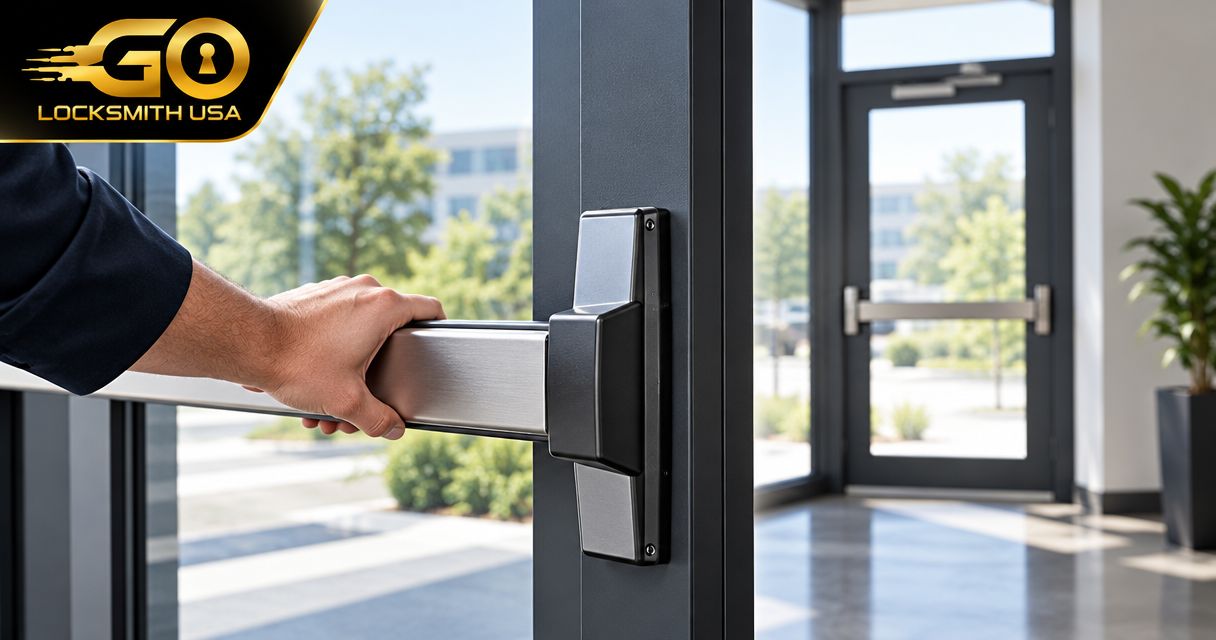
A rim exit device mounts on the interior face of the door and releases a latch at the door edge when you press the bar. For a compatible single door, it is a practical configuration to consider first because the main mechanism remains accessible on the door surface.
That recommendation is about configuration, not a promise that any rim device will fit. The strike, frame, door width, outside trim, and required listing still need to match.
Rim exit device pros:
- The surface-mounted mechanism is accessible for service.
- The configuration avoids vertical rods running to the top and bottom of the door.
- It offers a straightforward starting point for many single-door openings.
Rim exit device cons:
- A paired-door installation needs a suitable strike arrangement, often involving a mullion.
- Existing mounting holes and outside trim are not automatically compatible with a replacement.
- A narrow door stile can limit the devices that physically fit.
Best for: A single commercial door whose construction, frame, and requirements support a rim configuration.
Verdict: Choose a rim exit device as the default candidate for a compatible single door—not as an automatic replacement for every push bar.
2. Surface vertical-rod device: best for accessible paired-door hardware
A surface vertical-rod exit device uses visible rods to connect the push bar mechanism to latching points at the top and bottom of the door. It is a configuration to consider for compatible paired doors where the design does not use a center mullion.
The exposed hardware makes the arrangement easier to see during inspection. It also means rods, guides, and bottom latching components remain exposed to contact and need appropriate clearance.
Surface vertical-rod device pros:
- Rods and guides are visible for inspection.
- The configuration supports appropriate paired-door arrangements without a center mullion.
- Much of the hardware remains accessible from the door face.
Surface vertical-rod device cons:
- Exposed rods and guides can be struck by carts or other objects.
- Bottom latching depends on correct alignment and the surrounding floor condition.
- Adjustment involves more latching components than a typical rim arrangement.
Best for: Compatible paired doors where accessible surface hardware fits the building's use and maintenance needs.
Verdict: Choose surface vertical rods when the paired-door assembly calls for them and exposed hardware is acceptable. Do not remove a bottom rod or latch as an improvised fix; any alternative configuration must be approved for the specific assembly.
3. Concealed vertical-rod device: best for prepared paired doors
A concealed vertical-rod exit device places its connecting rods inside the door rather than on the visible door face. The arrangement suits doors designed and prepared to accept that hardware.
Concealment changes the appearance and protects the rods from direct contact. It does not eliminate alignment requirements or make the internal components maintenance-free.
Concealed vertical-rod device pros:
- Rods do not project across the visible door face.
- Internal rods are protected from direct impact by passing objects.
- The configuration supports compatible paired-door assemblies without exposed rod runs.
Concealed vertical-rod device cons:
- Accessing internal components can require more involved service.
- Door construction and internal preparation restrict compatibility.
- Changing from another device type can require substantial preparation rather than a simple hardware swap.
Best for: Paired doors already designed or prepared for a compatible concealed vertical-rod system.
Verdict: Choose concealed vertical rods for a suitable prepared door; skip an appearance-led conversion until compatibility is established.
4. Mortise exit device: best for existing mortise preparation
A mortise exit device operates a latching mechanism housed in a pocket within the door edge. The push bar releases that mechanism, while compatible outside trim controls entry according to the selected function.
The strongest reason to consider this configuration is an opening already prepared for it. A mortise device is not simply a rim device with a less visible latch.
Mortise exit device pros:
- It places the latching mechanism within the door edge.
- A compatible replacement can retain the opening's existing mortise arrangement.
- Suitable outside trim provides the required entry function for the selected device.
Mortise exit device cons:
- The mortise pocket and other preparation must match the selected hardware.
- Converting an unprepared door is more involved than surface mounting.
- Existing trim and cylinders need a compatibility check rather than an assumption of reuse.
Best for: A commercial door with existing, compatible mortise preparation and an appropriate specified exit arrangement.
Verdict: Choose a compatible mortise exit device when the opening already supports it; hold off on conversion until the complete assembly is reviewed.
Panic hardware and fire exit hardware are not interchangeable
Panic hardware allows a door to unlatch through operation of its push bar. Fire exit hardware serves that exit function while also being listed for use on applicable fire-rated door assemblies.
Mechanical dogging holds a device's latch retracted so people can pass without repeatedly operating the bar. Do not choose ordinary mechanically dogged panic hardware as a substitute for required fire exit hardware. Fire-rated openings need hardware and operation appropriate to the assembly's listing and applicable requirements.
UL 305 addresses panic hardware. UL 10C addresses positive-pressure fire testing of door assemblies. Those designations describe different evaluations; a claim about one does not establish compliance with the other.
A visible push bar also does not prove that an opening complies with building or fire requirements. Occupancy, door function, the applicable code, and the authority having jurisdiction determine what is required.
If you cannot establish whether the door is fire-rated, stop the purchase decision there. Preserve labels and obtain the relevant door and hardware information before approving changes.
Check the opening before ordering hardware
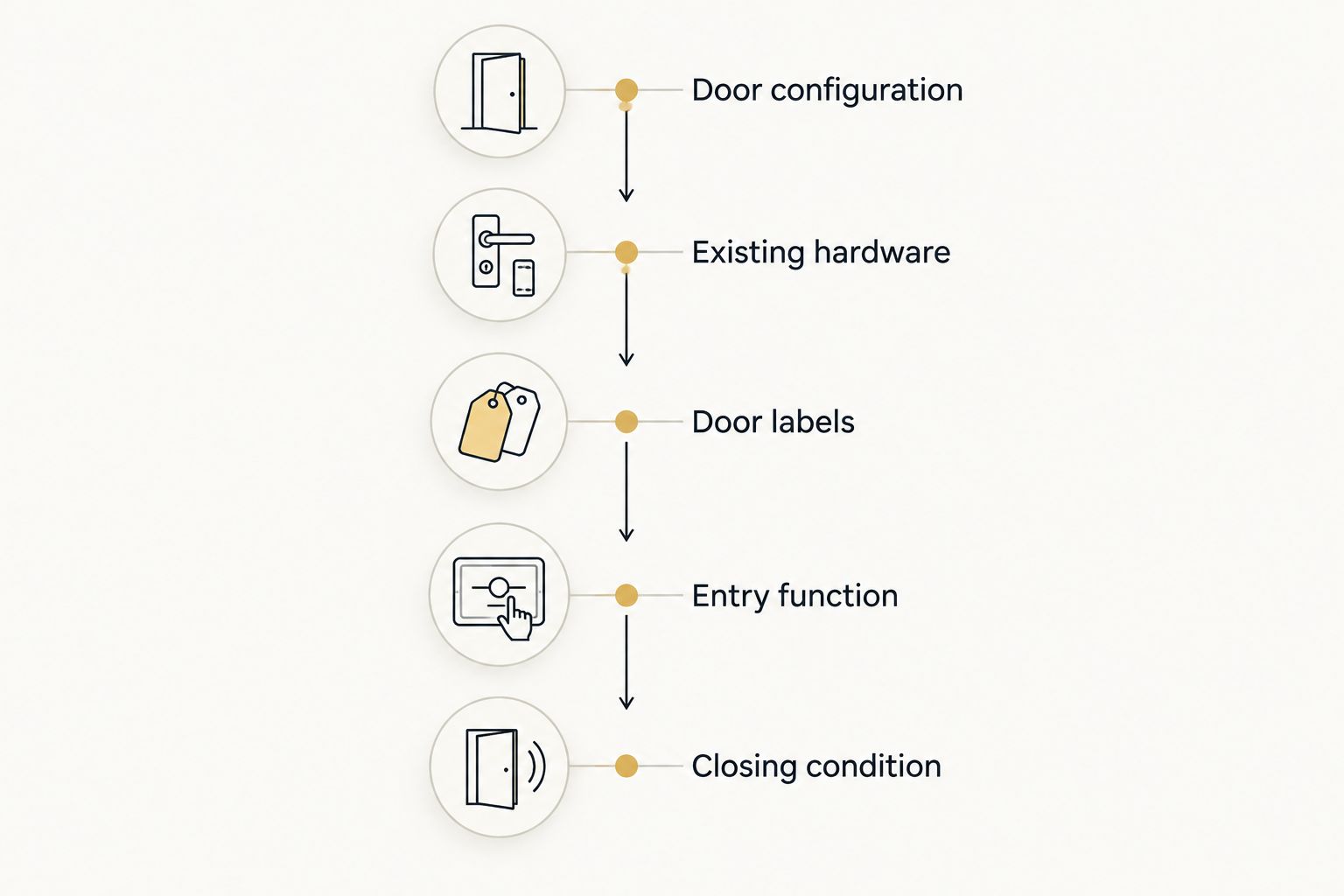
Use this sequence to turn a product search into a useful service conversation:
- Door configuration: Note whether the opening has a single door, paired doors, or a center mullion.
- Existing hardware: Record the manufacturer's name and model information where readable. Photograph the bar, door edge, strike, and outside trim.
- Door labels: Look for door and frame labels without removing, painting over, or damaging them.
- Entry function: Explain whether the outside should remain locked, allow keyed entry, or use another specified arrangement.
- Closing condition: Describe rubbing, sagging, incomplete latching, or a bar that does not return normally.
These observations help distinguish a device problem from a door or frame problem. For example, a door that rubs against the frame needs attention to that condition; replacing the bar alone does not establish correct closing and latching.
Do not dismantle unfamiliar exit hardware to identify it. Give the service provider clear photographs and explain the symptoms, then arrange assessment of the opening.
How these recommendations are ranked
The ranking starts with door compatibility, required listing, and existing preparation. Service access and entry function come next; appearance does not outrank correct operation.
Rim hardware is the default candidate for compatible single doors. The other configurations earn their places through distinct door arrangements, not because they are universally better or worse.
No manufacturer receives a performance ranking here. Without a specific model, listing, and opening specification, a brand-level verdict would not answer whether the hardware belongs on your door.
Which exit device should you choose?
Start with a rim exit device for a compatible single door. For paired doors, identify the existing latching arrangement before choosing surface or concealed vertical rods. Retain a mortise configuration when the existing preparation and replacement specifications support it.
For a Fort Myers business needing push bar service, GO Locksmith provides mobile commercial locksmith service. Call (239) 412-1101 to discuss the door, request a job-specific estimate, and check current availability.
Hours are Sunday–Thursday, 7:00 AM–11:00 PM, and Friday, 7:00 AM–5:00 PM. Saturday is closed; this is not a 24/7 service.
FAQ
What's the best push bar exit device for a single commercial door?
A compatible rim exit device is the default starting point for a single commercial door. Confirm the door preparation, frame, outside trim, and required listing before selecting a specific model.
Is a surface vertical-rod device better than a concealed one?
Neither configuration is better for every opening. Surface rods remain accessible and visible, while concealed rods sit inside a suitably prepared door and require different service access.
Can I put any push bar on a fire-rated door?
No; a fire-rated opening needs hardware appropriate to its listed assembly and applicable requirements. Ordinary panic hardware is not automatically a substitute for fire exit hardware.
Do double doors always need vertical-rod exit devices?
No; paired doors can use different approved hardware arrangements. The presence of a mullion, the door construction, and the required listing determine the appropriate configuration.
Can I reuse the outside handle when replacing a push bar?
Reuse depends on compatibility with the replacement device and its selected function. Check the outside trim, cylinder arrangement, and door preparation rather than assuming matching appearance means matching hardware.
Should I replace the push bar if the door won't latch?
A door that will not latch needs the complete opening checked before a replacement decision. Door alignment, the strike, the closer, and the device itself can affect closing and latching.
Can GO Locksmith help with a commercial push bar in Fort Myers?
GO Locksmith offers commercial push bar service in Fort Myers as a mobile locksmith service. Call (239) 412-1101 to discuss the door and check current availability during its confirmed business hours.
One last thing: the closer matters too
A working push bar does not make a door that fails to close and latch a finished repair. Check the complete closing cycle, not just whether pressing the bar releases the latch.
When requesting service, describe both directions of operation: what happens when someone exits and what happens after the door swings shut. That distinction gives a clearer starting point than saying only that the push bar is broken.